From your notes,
to study material.
Upload your PDFs, slides and documents. Ontica generates the summaries, practice exams and flashcards to study from — built from your own material, not the internet.
You already took the notes.
The lecture PDFs sit in one folder. The course slides are in your Downloads. The notes you wrote live in some Notion page you can't find.
The night before the exam you reread the same pages from scratch and rebuild the summary by hand — again.
"…photosynthesis converts CO₂ and water into glucose using light energy…"
chloroplast → site of photosynthesis · contains chlorophyll
"…cellular respiration is the inverse process — glucose plus oxygen, back to CO₂…"
Kelsen, Pure Theory of Law — Grundnorm as the validity-anchor of all positive law.
Your notes aren't dead. They're just scattered.
Ontica turns them into knowledge you can walk through — where every concept knows what it connects to, across every subject you've studied.
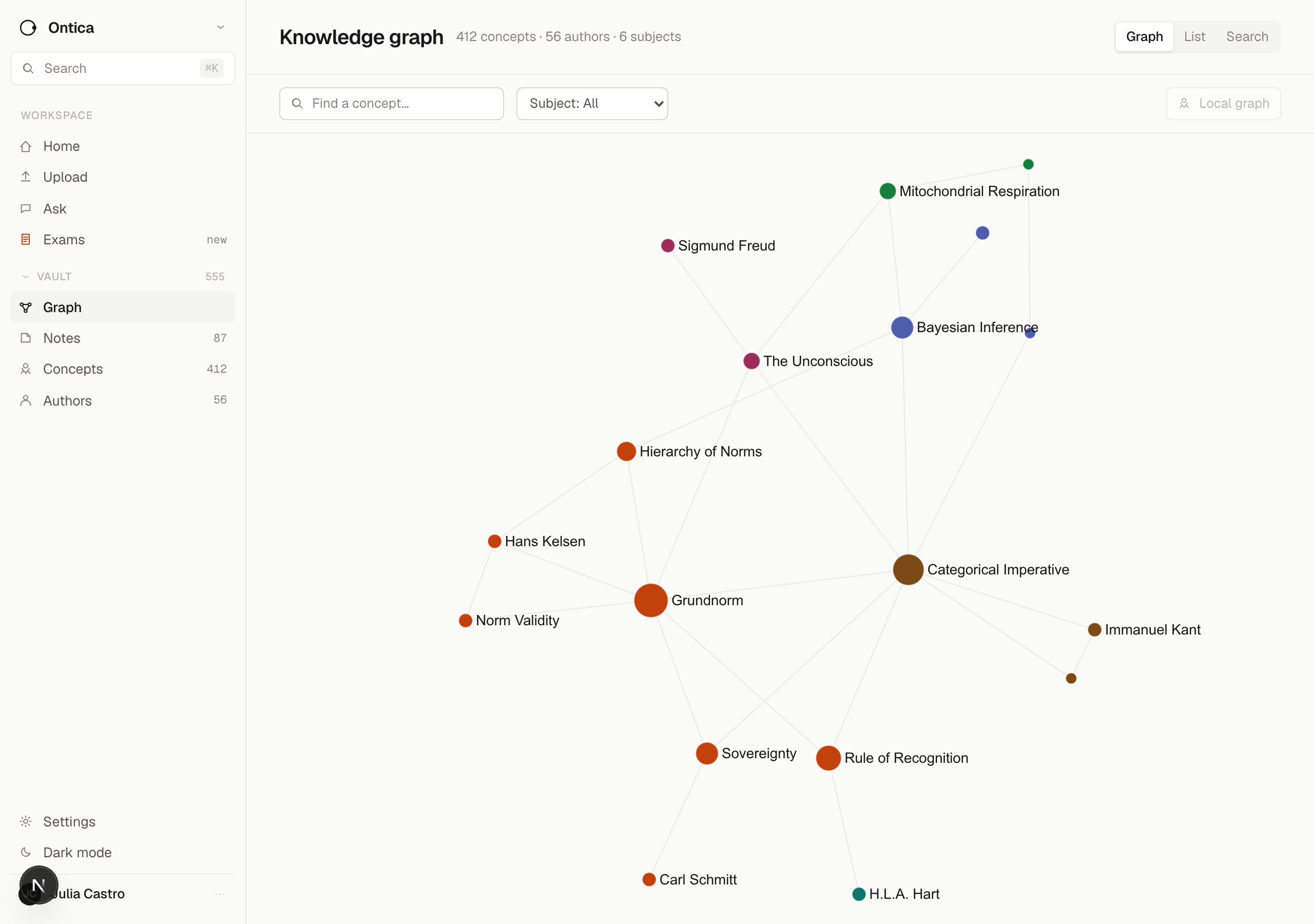
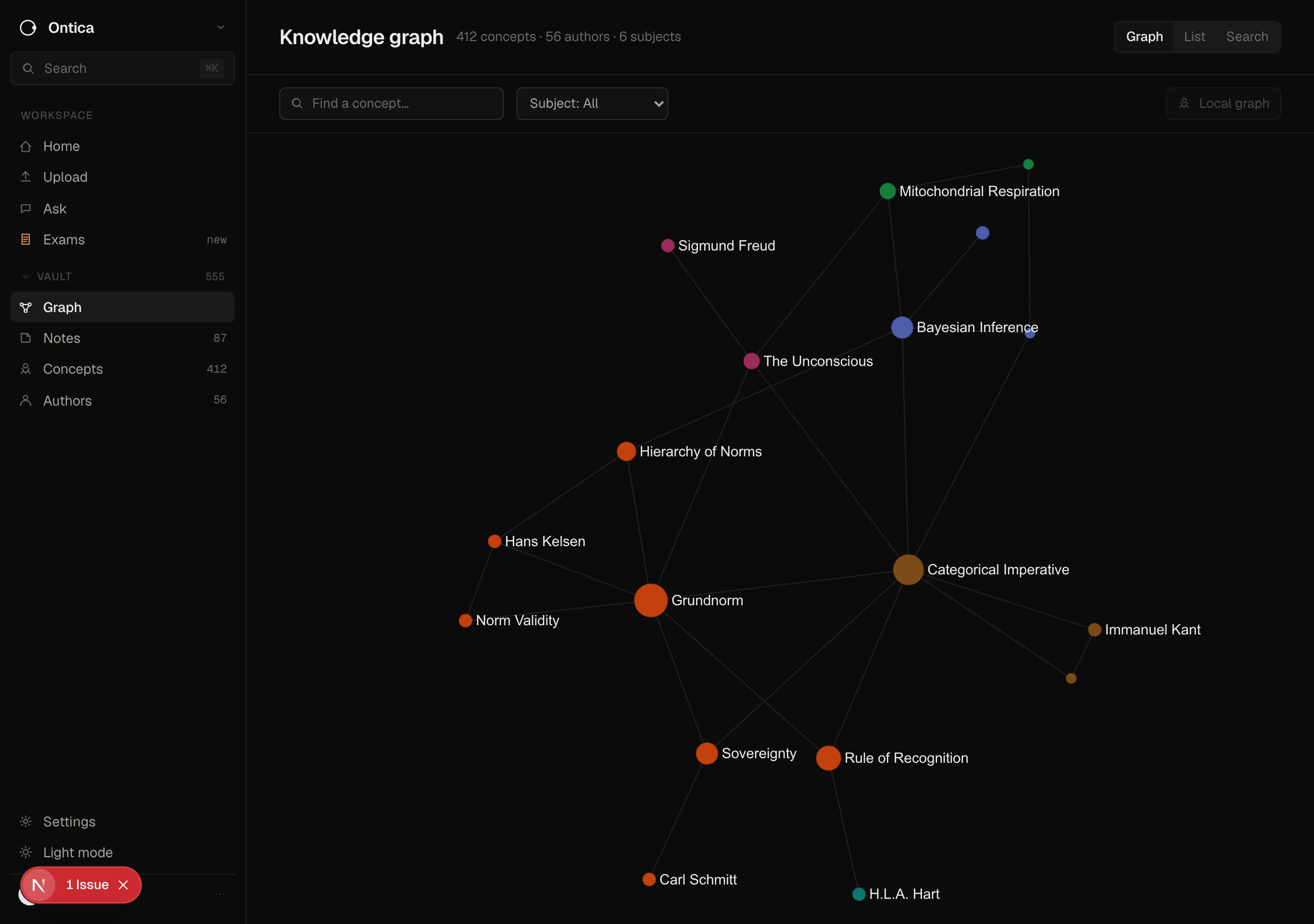
Your whole degree, as one navigable map.
Concepts and authors become nodes; what they do to each other becomes typed edges — cites, contradicts, applies. The link between a Heidegger concept and a constitutional case is finally explicit.
Ask your own material — with receipts.
Claude reads your graph and your notes, and answers citing the exact page or slide. Not the internet — your course, your professor, your reading list.
Turn it into practice exams, summaries and flashcards.
From your own graph, Ontica generates the material you actually study from — practice exams with model answers, summaries by topic, and flashcards. Every item cites your notes, not the internet.
Once it's in, everything works for you.
01
Capture once
Upload everything once — PDFs, slides, Word, Excel and text. Ontica reads it all and keeps the original next to what it extracts.
02
Indexed by itself
Every idea and author gets indexed, with its definition, sources and the links between them.
03
Study from your own material
Generate practice exams, summaries and flashcards from your notes — not the internet.
The fragments you already wrote down — a PDF, a slide, a line you copied verbatim from a textbook in october.
The structure that holds them together — a graph of relations across everything you've studied. The shape only emerges once the fragments are in one place.
You produce the first. Ontica builds the second.
For the way you actually study.
Ontica is in private beta, opening first to undergrad and grad students in the natural sciences, philosophy and law. Tell us what you study — we read every request.